
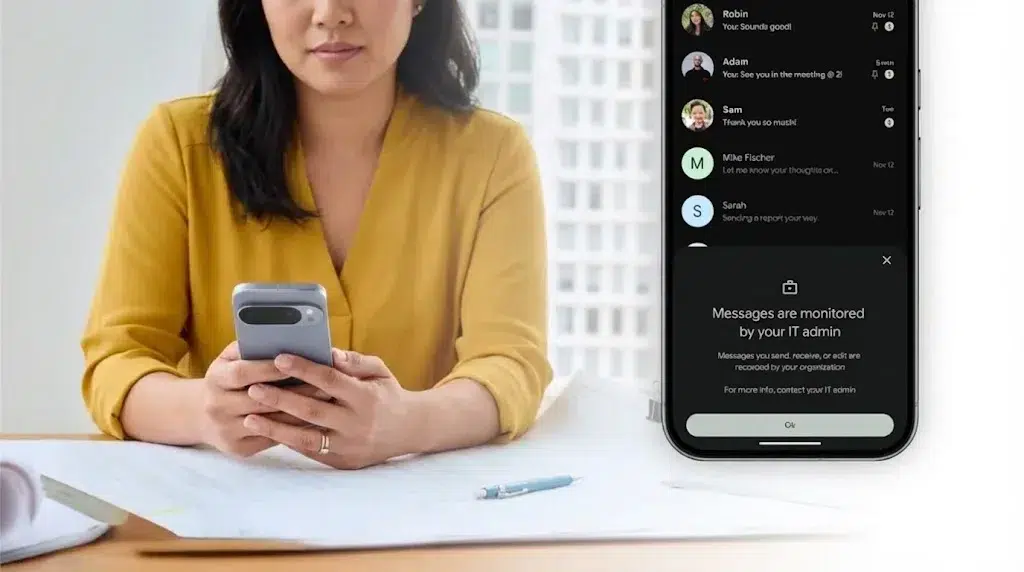
Google has quietly rolled out a major change that could shake the trust many Android users have — especially those using work-managed devices. With the latest update to Google Messages and Android’s RCS Archival setup, employers can now read and archive your text conversations on “company-managed” Android phones. (Android Authority)

In short: if you use a work-issued Pixel or Android Enterprise device, your private texts — RCS, SMS, even edits and deletions — could now be visible to your boss. Many are calling it a violation of privacy. And honestly, it feels more like a betrayal than a feature.
In this article, we’ll break down what exactly the “Google share text messages” change means, how it works, who it affects, and why critics say this might be one of the biggest privacy missteps in recent memory.
What Is the “Google Share Text Messages” Feature?
- Starting late 2025, Google enabled a new “RCS Archival” feature for fully-managed devices (like work-owned Pixel phones).
- Through this feature, third-party archival apps can hook into Google Messages. When enabled, every chat — sent, received, edited, or deleted — gets logged and stored for employer access. (Software Mirrors)
- The feature works not just for modern RCS chats, but also traditional SMS and MMS messages, ensuring backwards compatibility.
- Google claims that employees will “see a notification” when the archival feature is active.
Essentially, on a company-managed phone: encryption only protects messages in transit. Once messages reach your device, they become readable and archivable.
Who’s Affected — And Who Needs to Watch Out
This affects people using phones that are:
- Issued by their employer (work-managed Android / Pixel / Enterprise-enrolled devices)
- Running Google Messages as their default RCS/SMS client (i.e. many Pixel users or Android phones relying on Google’s RCS stack)
If you’re using a personal phone on a personal Google account — and it’s not managed by a company MDM (Mobile Device Management) profile — you’re likely unaffected. Google’s change targets “fully managed devices.”
So this isn’t “all Android users,” but for those under employer-managed devices, the change is huge, and potentially alarming.
Why Google Says It Did This — And What They Claim
Google frames this change as a compliance and regulatory tool. With end-to-end encryption and RCS making old carrier logging obsolete, companies in regulated industries need a way to archive employee communications. Google’s solution: integrate archival tools at the device level. That way, employers can stay compliant without relying on carriers.
From Google’s blog (as quoted by Android Central): “This allows third-party archival apps to integrate directly with Google Messages on a work device.”
They promise transparency: your employer must notify you when archival is active, and the feature is only meant for compliant enterprise devices.
On paper, that sounds reasonable — compliance, oversight, record-keeping. But in practice… many feel this crosses a privacy boundary.
Why This Is Causing Outrage — The Privacy Shock
Texts Are No Longer Private
For decades, people trusted their text messages as private communication: personal, direct, and protected. Now, on a work phone, that assumption no longer holds. With the “Google share text messages” update, what you type — personal messages, private chats, even deleted or edited messages — might live in your employer’s record forever.

Consent — But Under Pressure
Yes — Google says you’ll get notified. But in many workplaces, refusing might not be seen kindly. If your job depends on a company device, choosing privacy could feel like refusing cooperation. That power imbalance makes “consent” murky.
End-to-End Encryption? Rendered Meaningless
Google still says messages are encrypted in transit.
But once they land on a managed device, they’re decrypted and readable — effectively voiding the protection for recipients under company control.
A Dangerous Precedent for Workplace Surveillance
This opens the door to full-scale surveillance inside companies. Emails were already monitored in many firms. Now, even casual SMS or RCS chats could be part of archived logs. That could chill personal expression, especially if people start using company devices for personal conversations.
Anonymity & Trust Are Undermined
People may lose trust in company devices — or avoid using them altogether for personal use. Work phones might become just… devices for work, and any layering of personal life could feel risky.
What This Means for Workers — Reality Hits Hard
If you use a company phone:
- You should assume nothing you text is private. Treat every message as potentially archived.
- Edited or deleted messages are not gone — archival catches changes too.
- Employers may store thousands of messages with metadata (timestamps, recipients, edits) for compliance or legal reasons.
- Using your work phone for personal chats? Not a great idea anymore.
One tech-commentary site summed it up bluntly: “Your employer will now be able to read your RCS chats in Google Messages despite end-to-end encryption.”
For many, this feels like the end of privacy on work phones.
Is There Any Benefit — Or Is This Just a Surveillance Feature?
Google argues there are reasons for businesses to archive communications:
- Regulatory compliance (especially in finance, healthcare, legal sectors)
- Record-keeping for corporate communications and audit trails
- Internal policy enforcement and liability protection
But critics argue:
- This blurs the line between “work” and “private life,” especially if people occasionally use work phones for personal stuff
- E2EE loses meaning once enterprise-level monitoring is introduced
- The power imbalance between employer and employee may pressure people into self-censorship
In short: the “benefits for companies” come at a steep cost — personal privacy and trust.
Public Reaction — The Backlash Is Real
Social media and privacy forums have exploded with outrage. Comments like:
“Texts are no longer private.”
“If you thought company phones protected privacy — think again.”
On Reddit’s privacy threads, many are warning against using company-managed phones for personal use. One user wrote:
“If you ever thought you had privacy using company equipment, then this must be a shock to you.”
Privacy advocates are calling it “a massive overreach,” warning this could become standard across industries.
Union representatives and labor rights groups are already calling for stricter regulation — arguing that even regulated data retention should not mean unfettered access to personal chats.
What You Can Do If You’re Affected
If you’re using a work-managed Pixel or Android device, here are some steps to protect yourself:
- Assume all chats are monitored — avoid personal communications on work phones.
- Use personal devices for private conversation. Keep work phones strictly for work.
- Avoid sensitive topics on work devices (banking, personal relationships, private matters).
- Use strong passwords and enable 2FA on all personal devices and accounts.
- Know your rights. If you’re in a region with data privacy laws (like GDPR, etc.), check whether message monitoring and storage require explicit consent.
- Use encrypted messengers on personal devices (outside of work phones) for private chats.

If enough people adopt safer practices, maybe the damage can be limited. But make no mistake — this update changes how work phones work forever.
Broader Implications — What This Means for the Future of Digital Privacy
The “Google share text messages” change may just be the beginning of a larger shift:
- More companies may adopt enterprise-level surveillance tools, not just for calls and email — but for texts, chats, and even metadata logs.
- The concept of “private texting” may erode, especially for employees using company-managed devices.
- Trust in work-issued devices may decline — employees may avoid using them for personal communication altogether.
- Demand for truly private communication tools (not tied to corporate hardware) might rise again — boosting adoption of third-party encrypted platforms.
- Regulators and privacy advocates may push for stricter legislation to protect personal communication privacy, even on work devices.
If you think of texting as a private resource — this update may serve as a wake-up call.
Final Thoughts — When Convenience Becomes a Threat
The new “Google share text messages” update marks a major turning point in workplace communication — but not one most users asked for. Google’s nod to compliance and regulation ignores a core fact: texting has long been a private space, even more intimate than email for many.
By allowing employers to archive every conversation — including edits and deletions — Google has rewritten privacy rules for work phones. For employees, this might be the end of personal chats on company devices.

Yes, there may be legitimate business reasons for this feature. But when convenience and compliance come at a cost to personal privacy — you have to ask: is it worth it?
Because once private texts become public to your employer … the line between work and personal life disappears.
For more such stories do visit us @Brnd Guru

